

People will forever have the desire to travel, and hitting the road in a campervan is one of the greatest ways to explore. But in a world where electric vehicles are becoming more common, where does this leave campervans? Are electric campervans the future? Read on to find out everything you need to know about buying and owning an electric campervan.
You can also speak directly to industry experts at our upcoming electric campervans workshop on the 15th of February.
Will diesel and petrol vans be banned?
Micheal Gove (former environmental secretary) first introduced the ban on diesel and petrol in 2017. This will come into effect in 2030, meaning all new conventional petrol and diesel cars will be banned from sale in the UK. New hybrids will continue to be sold until 2035 on the condition that they can travel a ‘significant distance with zero emissions’. Following 2035, the only new vehicles available will be purely electric.
When should I make the switch to electric?
We are all too aware of the climate and ecological crisis we are facing, going electric is a clear part of the solution and we believe the sooner we make the switch the better chance we have of staying under that crucial 1.5C warming limit.
Additionally, the number of electric vehicles on the road will continue to rise in years to come as the demand increases and the manufacturers prepare for the 2030 deadline. This means you will not only struggle to find a petrol or diesel van with low mileage, but you’ll also start to notice a reduction in parts available for repairs.
Buying an electric campervan
Types of electric Campervans
There are two types of electric campervans; new purpose-built vehicles and retrofitted classic vehicles. There are a number of differences outlined below
New Electric
New Electric simply refers to vehicles that have been built 100% electric that either is already or can be converted into a campervan. You can buy these brand-new or second-hand. Availability of brand-new electric vans is increasing rapidly and electric delivery vehicles are now starting to show up on the second-hand market, however for now this is mostly smaller and shorter-range models.
Retrofit
This option takes an existing petrol/diesel van and converts it to be fully electric removing the engine and replacing it with an electric motor. At present, you can re-register a change in fuel type with the DVLA for vehicles manufactured before 2000 but new vehicles are riskier.
How much do they cost to buy & convert?
New Electric
The cost of the vehicle varies depending on the model, wattage and range you desire. You will find New Electric vehicles on the market for anything between £25-80k for the base van and an additional £15-40k for the conversion depending on what spec you want. Please take a look at our electric campervan comparison table below which compares different models, ranges and pricing.
Retrofit
Suppose you’re looking to have a classic camper converted into an electric campervan. In that case, you’ll pay between £15-25k for the campervan itself and an additional £45-65k to have it converted to be fully electric.
Take a look at our Electric Vehicle Comparison Table below which compares different models based on their range, battery size, payload and price.
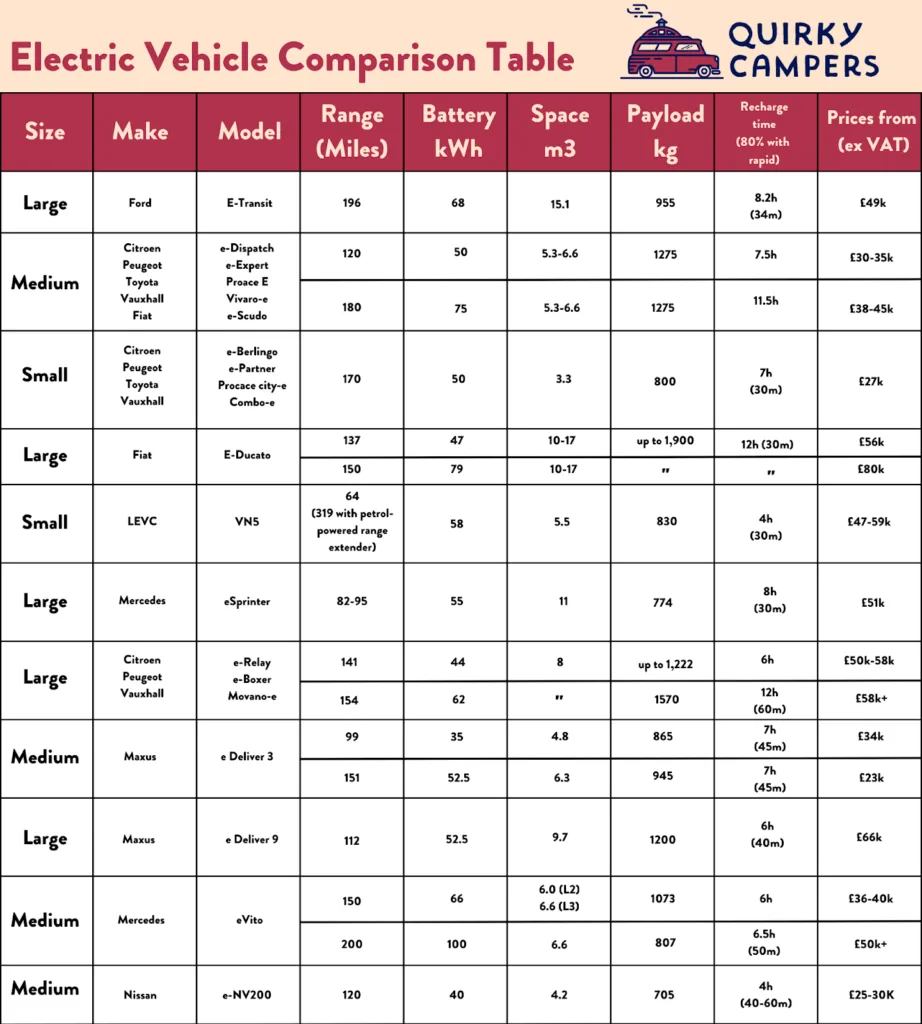
*Please note all figures above are approximate. Vehicle details are indicative and will vary depending on the precise specification.
Where can I buy an electric campervan?
Ready to hit the road
There aren’t yet many options for buying ready-made electric campervans in the UK, but here are a few:
Or you can commission someone else to do this depending on the type of vehicle you want:
Retrofit
Here are some converters with experience converting petrol/diesel vans into fully electric campervans:
New Electric
Check out these converters with experience of doing campervan conversion on new electric vehicles:
Electric campervan converters will continuously be added to our converter directory.
What vehicles are suitable for retrofit?
Any petrol or diesel vehicle pre-2000 can be converted into an electric vehicle. The older the better, which is why you’ll often see classic VWs converted to electric. The reason newer vehicles are more difficult is because of other computerised engine management systems (ECU). So the easiest vehicles to convert are typically those about before N reg.
To get insurance you will have to re-register the vehicle with the DVLA. They have clear guidance on this for vehicles pre-2000 but for newer vehicles, there is no guidance. It has been done but there is the risk the re-registration for a change of fuel will be rejected.
Maintenance
Are they more expensive to maintain?
Not at all, in fact, they’re cheaper to maintain. An electric drivetrain (responsible for delivering power from the battery to the wheels) has much fewer moving parts meaning there’s less that can go wrong. So there will be no oil, cooling fluid and fuel filters that need changing, and no timing belts to replace. The main items you’ll need to service are the pollen filter, brakes and windscreen washer fluid etc.
Will I need an MOT?
Yes. Similarly to any vehicle, new electric vehicles require an MOT after 3 years and every year following.
The same applies to retrofit campers. Whilst legally you may not be required to get an MOT on vehicles registered over 40 years ago, it is strongly recommended if you plan to use your vehicle on public roads. Bear in mind, an EV has much more power so it is crucial you continue to have your brakes and seat belts checked.
Do I pay road tax?
No, currently fully electric vehicles are exempt from paying road tax. You must tax your vehicle even if you are exempt, find out more here.
What happens if I run out of charge?
Similarly to a diesel/petrol that runs out of fuel, you’ll break down and will need to contact a breakdown recovery to tow you to the nearest charging station. RAC now have specialist EV cover which includes EV boost. So if you run out of charge, RAC EV boost vans can give you a 10-mile boost to get you to the nearest charging point.
Logistics
Where can I recharge?
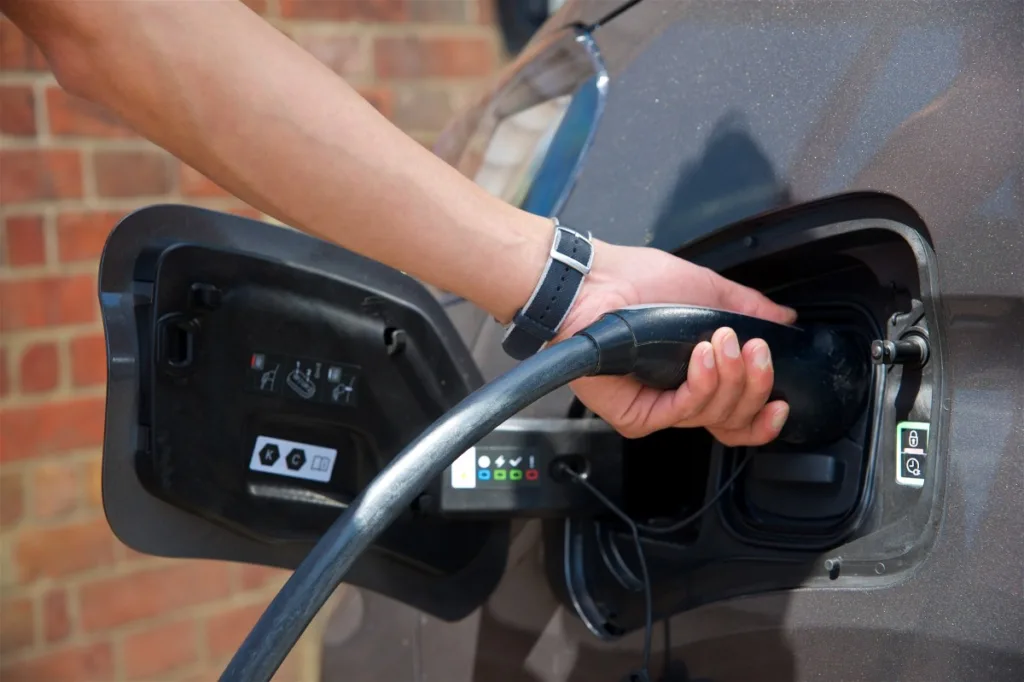
Rapid chargers are available at petrol stations and supermarkets throughout the UK, meaning you’re never too far from a charging point. Here is a handy guide on which supermarkets currently offer free charging. Some independent campsites and most caravan and motorhome sites facilitate electric vehicle charging. There are apps such as Zap Map available that highlight over 14,000 charging points across the UK and Ireland. They also have a feature where you can plan your journey, so you can spend less time faffing in google maps and more time getting excited about your adventure.
Take a look below at the different types of charging and approximate charging times.
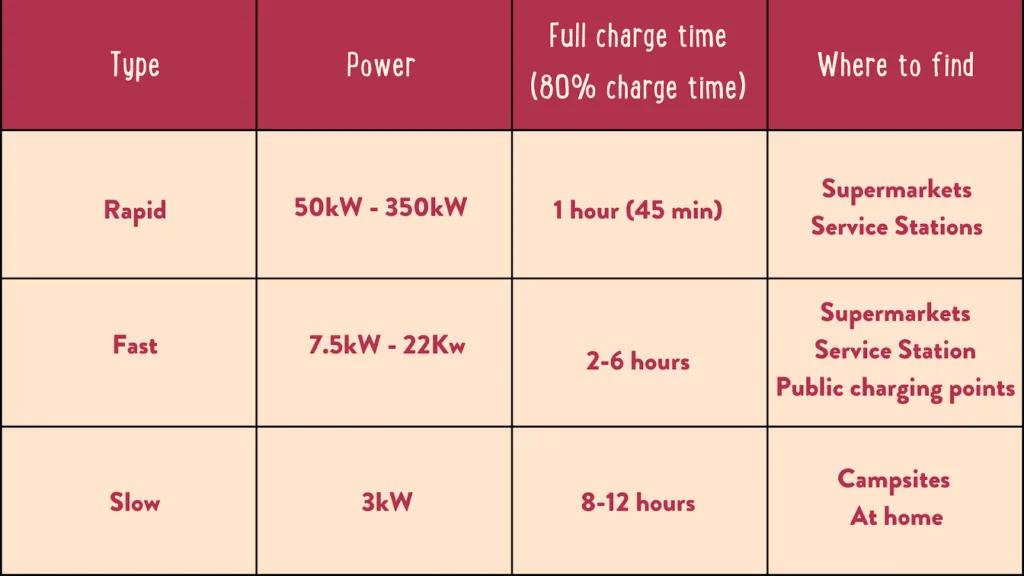
An easy way to calculate the charging time is by dividing battery capacity by the rating of the charging point. E.g 68kWh/50kW = 1.4 hours
How much does it cost to recharge?
There is a huge variance in the cost of recharging depending on convenience, speed and location.
Free options: Some supermarkets offer free charging whilst you shop, so it’s worth researching ahead. Scotland is particularly good when it comes to finding free public EV chargers. Check out this blog by Zap Map which details exactly where you can find free devices. Some National Trust locations have free ‘fast chargers’ which are perfect if you’re stopping off for a few hours and in certain locations, National Trust members are even allowed to park overnight for free!
Below are some example prices per kWh for different types of charging:
- Campsite hook-up: Often included in your pitch fee or charge eg £4/night – Slow
- Home: £0.32 – £0.35 – Slow
- Public fast chargers: £0.20 – £0.60
- Public rapid chargers: £0.40 – £1 (£0.70 average Jan 2023)
Depending on your vehicle and driving style 1kWh will get you between 2-5 miles.
Typically the cost per mile for an electric vehicle is between £0.07 and £0.12. An equivalent diesel vehicle would be at least double this figure with £0.28 being the average for a van. However, if you use a lot of expensive ultra-rapid charging you could end up with a cost per mile of as much as £0.35.
How far can I travel on a full charge?
How far an electric campervan can travel varies hugely depending on model, weight, weather conditions, speed and so on. For example, a cold climate could reduce the battery’s performance by 10-12%. This calculator gives a really good idea of how different factors can affect range (it’s designed for the e-dispatch but the principles apply to any EV).
Take a look back at our handy Electric Campervan Table which compares different models and ranges.
Differences in converting an electric vehicle
Do electric campervans have a higher payload?
No. Typically electric vehicles weigh more than their diesel equivalent because of the weight of the batteries. As a result, they have a lower payload so the weight of the conversion is going to be even more critical. The Electric Vehicle Comparison Table above shows the payloads of some vehicles but watch out, higher range versions of the same model will have a lower payload because the batteries are heavier.
Check out our weight blog to find out more about vehicle weight and how to manage it.
Can the vehicle batteries power your living space?
Needing a separate electrical setup for your living space i.e fridge, hobs, lights etc, entirely depends on the type of electric campervan you have. It is possible for your vehicle to be powered by your vehicle batteries, however, it’s not advisable as this may affect your range and solar charging can be trickier.
It is not recommended for New Electric campervans as it would require alterations to the electrical system, voiding the warranty. It may be possible on older vehicles using a DC to DC, however, this would be the case when the key is in the ignition, making it an unreliable option for those wanting to spend time off-grid.
To gain the full campervan experience, it is recommended that you have a separate 12-volt system to power your living appliances. The general setup of the 12v system doesn’t differ from what you would install in a diesel/petrol van; you would still have a leisure battery and be able to install solar panels to charge it.
Can you charge the engine batteries using solar power?
It may be possible for New Electric campers outside of warranty but you would need a DC to DC charger. This may also be possible in the future for Retrofit but currently, the voltage gained by solar wouldn’t be enough and the impact would be quite small (approximately around 30 miles for a full day’s sun.)
Whilst this is yet to be done on a wider scale, a group of dutch students have done it. They have built a completely solar-powered campervan which can travel up to 460 miles on a sunny day, could this be the future of electric campervans? We’ll have to wait and see. You can see their creation here.

Try before you buy
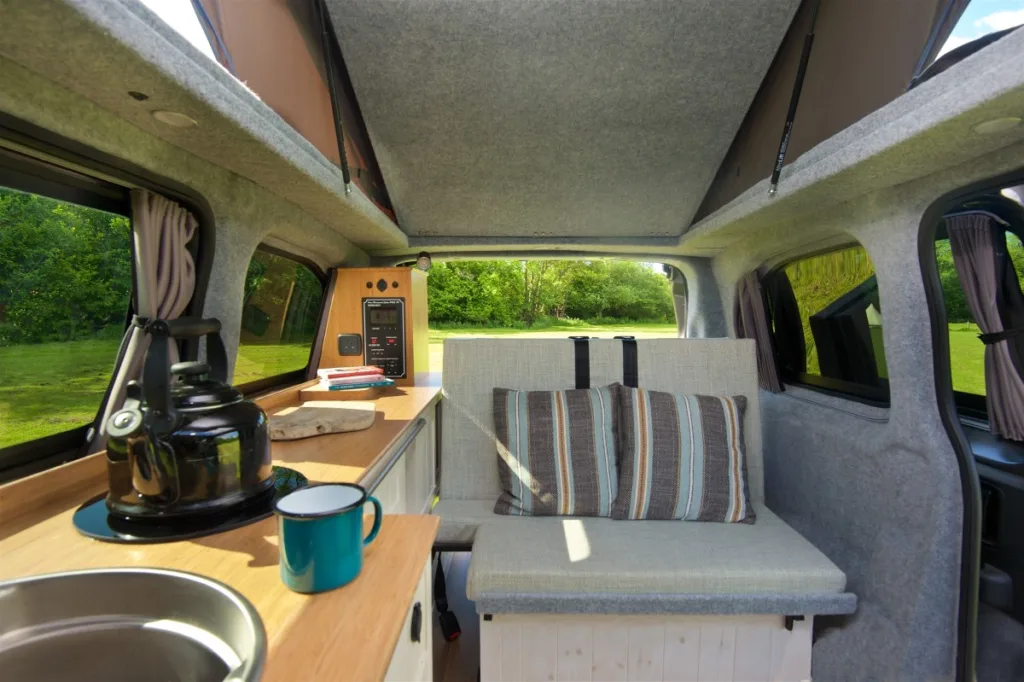
Want to know how it feels to drive an electric camper? Here at Quirky, we’re big believers in the ‘try before you buy method’. Hiring an electric campervan before committing to purchasing one will give you a better idea of which method and/or vehicle is the right choice for you.
Eve
Kickstart your sustainable journey in the one and only Eve. The first ever electric campervan to join the Quirky fleet, Eve is the perfect choice for families looking to unlock some new core memories. This Citroen E-Dispatch has an approximate range of 150 miles but with her being located in Brighton, you won’t need to travel far for an epic family getaway.
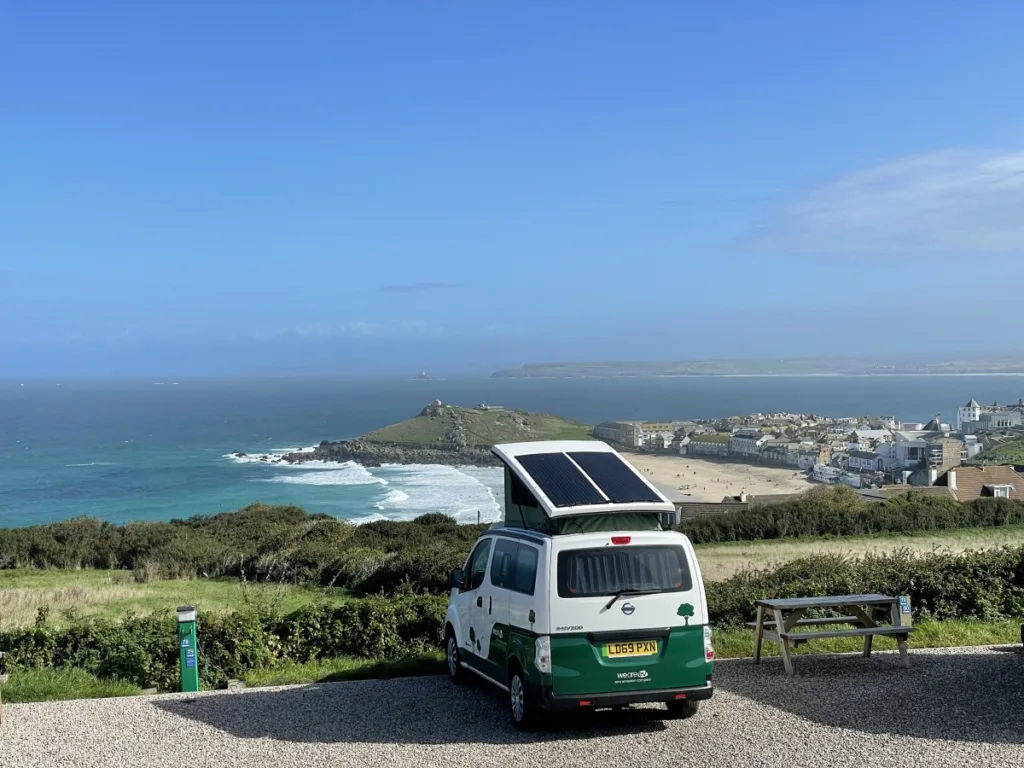
Ohmer
Charge into adventure with this new electric camper Ohmer curated by We Are EV. Located in Bristol, the glorious welsh coast is right around the corner. Kickback and relish in the fact you have everything you need at your fingertips whilst Ohmer soaks up the solar. Fitted with twin induction hobs, an outdoor shower and a pop top, you’ll have everything you need to stay comfortable on the road.
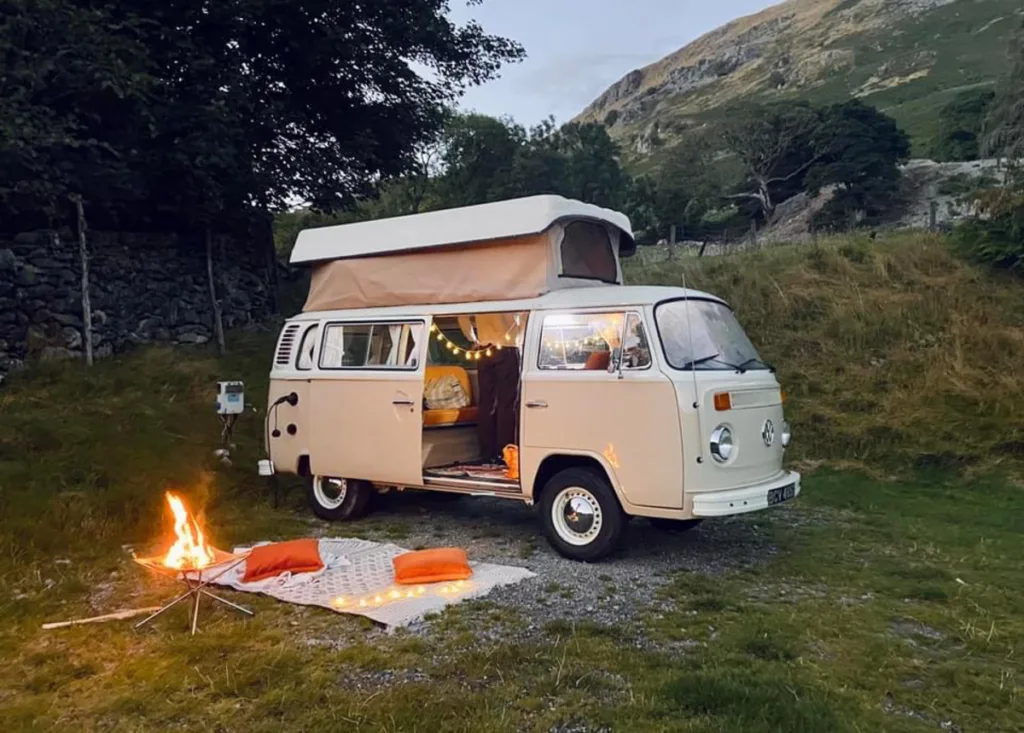
eDub Indie
Meet eDub Indie aka eDub Maggie’s bright and colourful younger brother. Forget what Kermit says, eDub Indie showcases just how easy it is to be green. His size is compact enough to make him easily navigate country roads but big enough to house a spacious living area. Fitted with a heater, pop top and dual induction hobs, you’ll have everything you need for your planet-positive adventure.