


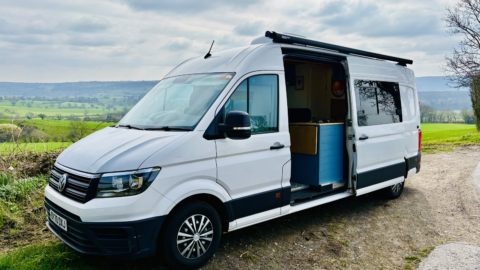
The VW Crafter has a dedicated following, and the people who own one tend to be evangelical about it. Bigger and more refined than a Transit, cheaper than a Mercedes Sprinter, and with a reputation for solid mechanical reliability when maintained properly. For buyers willing to spend a bit more on the base vehicle, it’s one of the most sensible choices on the UK market.
But “VW Crafter” covers two entirely different vehicles depending on the year, and the pre-2017 models share almost nothing with the current generation. Knowing which one you’re looking at is the first thing to get right.

The Mercedes-built years: 2006 to 2016
Here’s the bit that trips up most first-time Crafter buyers. Until 2017, the Crafter was built by Mercedes-Benz for VW at the Ludwigsfelde and Düsseldorf factories in Germany, on the same production lines as the Mercedes Sprinter W906. The body shell, chassis and platform are essentially a rebadged Sprinter. Same dimensions, same doors, same load area layout.
The engines, though, are all VW. From 2006 to 2011 the Crafter used the VW 2.5 TDI R5, a five-cylinder common-rail diesel that’s unique to the Crafter in commercial vehicle form. From 2011 until the end of the first generation in 2016, it switched to the more modern VW 2.0 TDI, which offered better economy and emissions compliance. Both are VW Group engines with nothing mechanical in common with the Mercedes CDI units you’d find in a Sprinter of the same era.
This matters in practice. Body panels, chassis parts and running gear can often be sourced through Mercedes channels because the platform is shared. Engine parts, diagnostics and service data need to come from VW specialists. If you’re buying a Crafter, find an independent VW commercial garage rather than assuming any Sprinter specialist can handle it. The 2.5 TDI R5 in particular has known issues with early turbo failures (largely fixed in a 2010 revision), DPF problems on short-journey vans and injector wear on higher-mileage examples. The later 2.0 TDI is generally the more refined engine but shares the typical VW diesel weaknesses: EGR clogging, injector seals and occasional turbo issues.
For conversion buyers, this first generation is still genuinely good value. A properly maintained example with a tidy conversion will happily cover 250,000 to 300,000 miles. A good pre-2017 Crafter conversion at £18,000 to £25,000 is one of the better value propositions in the UK used market right now.
The VW years: 2017 onwards
In 2017 VW started building the Crafter itself in a new plant in Poland. The current Crafter shares nothing with the Mercedes Sprinter. Different engine (a 2.0 TDI), different chassis, different transmission, different electronics. It’s a proper VW commercial vehicle and it feels like one.
The driving experience is a clear step up. The cabin is more car-like, the infotainment is modern, the ride is quieter and more composed. Fuel economy improved, and the newer Crafter is available with front, rear or all-wheel drive, which the older generation never offered. For anyone planning serious winter use or regular trips to more remote areas, the optional AWD is a genuine advantage over most rivals.
The downside is price and, on very early examples, some teething issues with the 2.0 TDI injection system. Later examples (2019 onwards) are more trouble-free. Expect to pay £30,000 plus for a decent converted post-2017 Crafter, and well over £50,000 for a high-end professional build.

Why Crafter buyers tend to spend a bit more
A Crafter conversion generally attracts buyers who want a long-term van rather than a stepping stone. The base vehicle is more expensive to buy, more refined to drive and holds its value better. That means converters building on Crafters tend to invest in higher quality fit-outs because the buyer is already committed to spending more. You rarely see a cheap, rough self-build on a Crafter base. It’s usually either a careful owner-build or a proper professional conversion.
This is why the Quirky Campers marketplace tends to have Crafter conversions at the higher end of the price range. The buyers looking at them expect quality, and the sellers know it.
What to check on a Crafter before you buy
Regardless of generation, there are five things worth checking properly on any Crafter you’re considering.
Service history is the big one. A Crafter with a patchy service book is a gamble. These engines respond well to regular oil changes and timely cambelt and water pump service. Skipping those will catch up eventually and the repair bills are not small. Ideally you want to see stamps at sensible intervals and receipts for any major work.
Rust on pre-2017 models. Check the rear wheel arches inside and out, the sliding door sill and the rear crossmember. Mercedes-based Crafters suffer the same rust hotspots as Sprinters of the same era, and a clean-looking van can hide meaningful corrosion underneath.
The dual mass flywheel and clutch. Both generations can eat DMFs if the previous owner was rough with the clutch. Listen for a rattle at idle, particularly with the clutch engaged. Replacement is a thousand-plus job.
The habitation electrics, gas and water systems. Our campervan electrics guide explains what a good install looks like, and a proper pre-purchase checklist covers damp, gas certification and conversion quality. On a £25,000+ van, cutting corners on these checks is false economy.
Finally, the reclassification status and V5C. If the van has been converted and registered as a motor caravan, check the V5C body type field says so. The requirements are covered in the DVLA reclassification guide. It affects speed limits, insurance quotes and resale value.

Typical prices in 2026
Rough numbers from what we see in the UK market right now. A pre-2017 Crafter with a tidy self-build conversion sits around £18,000 to £25,000. A professionally converted pre-2017 Crafter with proper electrics, gas and a Webasto heater runs £25,000 to £35,000. Post-2017 Crafters start around £30,000 for simpler conversions and go well past £60,000 for high-end professional builds with lithium batteries, showers and off-grid solar setups.
Long wheelbase versions command a premium because they accommodate a proper fixed bed with a garage underneath, which is the layout most buyers want. Short wheelbase Crafters are rarer on the used market and can be surprising value if you find one.
Crafter or Sprinter or Transit?
If you specifically want a premium base vehicle, you’re choosing between a Crafter, a Sprinter and an Iveco Daily. A Transit is a step down in refinement and price, which is fine if that matches your budget and priorities. The Crafter sits in a sweet spot. More refined than a Transit, often cheaper than an equivalent Sprinter (especially in the current generation), and with a solid reputation for going the distance.
For buyers who plan to use the van for a decade and want a base vehicle that won’t let them down, the pre-2017 Mercedes-built Crafters in particular are one of the best-value buys in the current market. Browse the current Crafter campervans for sale and you’ll quickly see why they’re so popular with owners who actually use their vans rather than just store them.